
When I first started learning Korean, I thought the fastest way was to grab a list of 1,000 words and memorize them. I still remember sitting at my desk, chanting: 사과 means apple, 학교 means school, 사랑 means love… Within days, I forgot almost everything.
That’s when I realized something important: learning Korean vocabulary for beginners isn’t about cramming random words—it’s about building memory through context, frequency, and fun.
In this article, I’ll share how to learn Korean vocabulary the smart way—so that words don’t slip away the moment you close your notebook.
1. Why Random Word Lists Don’t Work
Here’s the truth: memorizing “word = translation” rarely sticks.
- You may remember it today, but forget it tomorrow.
- Words feel like isolated dots with no meaning.
- You don’t know how or when to use them.
Example: You learn “사과 = apple.” But if you don’t use it in a sentence, will you remember how to say “I ate an apple yesterday”? Probably not.
👉 Instead, focus on words in context and frequency of use.
Read Also: Jin Biography: The Handsome Voice of BTS
2. The High-Frequency Word Method
Research shows that the top 500 most common Korean words appear in the majority of daily conversations. Learning these gives you immediate practical ability.
Examples of High-Frequency Words:
- 집 (jip) = house
- 먹다 (meok-da) = to eat
- 가다 (ga-da) = to go
- 좋다 (jo-ta) = good
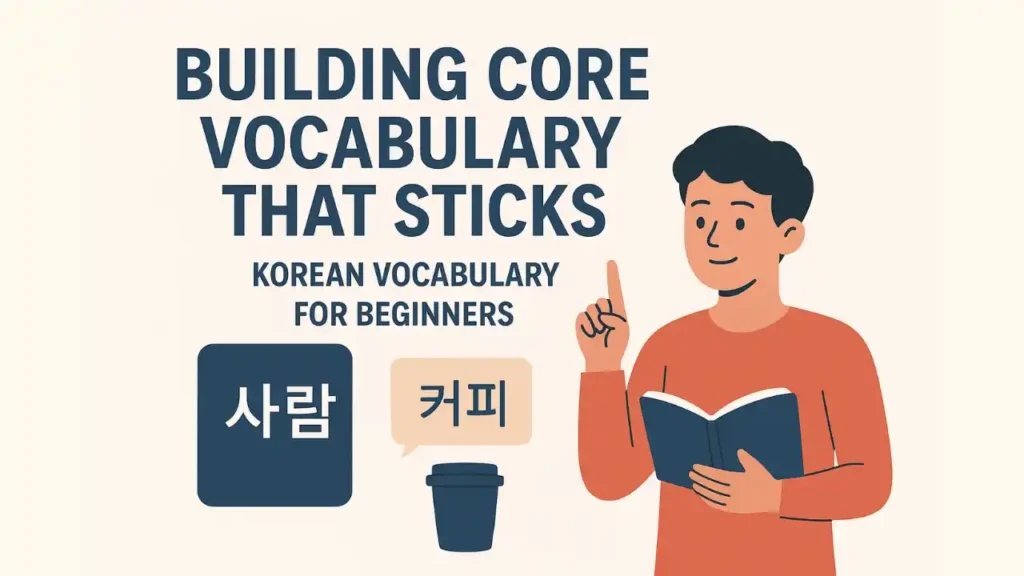
- 사람 (sa-ram) = person
Instead of chasing 5,000 words, start with these. With 500–800, you can handle everyday conversations, K-dramas, and travel.
👉 Tip: Search for “Korean Top 500 Word List” online—it’s free and beginner-friendly.
3. Learn Words in Context
This is the golden rule: don’t just learn words—learn phrases and sentences.
- ❌ Memorize: 학교 = school
- ✅ Learn: 저는 학교에 가요 = I go to school.
By attaching words to sentences, you get:
- Grammar practice.
- Real-life usage.
- Stronger memory (your brain remembers patterns, not isolated items).
👉 Write 2–3 sample sentences for every new word you learn.
4. Konglish Words: Quick Wins for Beginners
Here’s a secret weapon: Konglish Words.
Korean has many borrowed words from English. They’re written in Hangul but sound very familiar.
Examples:
- 커피 (keo-pi) = coffee
- 택시 (taek-si) = taxi
- 비디오 (bi-di-o) = video
- 컴퓨터 (keom-pyu-teo) = computer
- 피자 (pi-ja) = pizza
Learning these gives you instant confidence—you already know them! Plus, they help you practice reading Hangul.
Read Also: J-Hope Biography: The Story of BTS’s Third Member
5. The Power of Spaced Repetition
One of the smartest ways to remember vocabulary is using Spaced Repetition Systems (SRS) like Anki or Quizlet.
Here’s how it works:
- Day 1: Learn a new word → review it after 10 minutes.
- Day 2: Review again.
- Day 4: Review again.
- Day 7: Review again.
The app automatically shows you words just before you forget them—so they stick long-term.
👉 Example: Add “사랑해 (I love you)” into Anki with audio and a sample sentence. In weeks, it becomes natural.
6. Daily Routine to Build Korean Vocabulary
Here’s a simple plan for beginners:
- Morning (10 mins): Review 10 flashcards on Anki.
- Afternoon (10 mins): Read 2–3 new words in sentences.
- Evening (10 mins): Watch a drama or listen to K-pop—spot familiar words.
- Before bed (5 mins): Write a short journal entry using at least 2 new words.
That’s just 30–35 minutes a day. Consistency beats intensity.
7. My Personal Breakthrough
I remember the moment it clicked for me. I was watching a drama when I heard the actor say:
“배고파” (bae-go-pa) = I’m hungry.
I smiled, because I had learned not just the word “배” (stomach), but the phrase. It wasn’t just vocabulary—it was real communication. That moment proved that the right method works better than endless lists.
Read Also: Tata Next-Gen Nano 2025: India’s Cheapest 4-Seater Car at ₹80,000 with 500KM CNG Range
FAQs About Korean Vocabulary for Beginners
How many words do I need to speak Korean?
With 500–800 words, you can handle basic daily conversations. Around 2,000 words gives you fluency in most everyday situations.
Should I learn vocabulary or grammar first?
Learn both together. Vocabulary without grammar is useless, grammar without words is empty.
What’s the best app to learn Korean vocabulary?
Anki (for spaced repetition) and Memrise/Quizlet (for themed vocabulary sets).
Should I translate words into English or think in Korean?
At the beginning, English is fine. Over time, try to connect words directly to images or feelings (like 어린이 = child → picture of a child).
How can I make Korean vocabulary learning fun?
Use K-pop, dramas, or games. Turn it into a habit, not homework.
Conclusion
So, what’s the secret to learning Korean vocabulary for beginners? Don’t waste time on random word lists. Start with high-frequency words, learn them in sentences, add Konglish for confidence, and use spaced repetition to remember them forever.
Vocabulary is not about memorizing—it’s about living the words. When you watch a drama and suddenly recognize “사랑해” (I love you) or order “커피” at a café in Seoul, you’ll realize: this isn’t just study—it’s connection.
👉 Your next step: download Anki or Quizlet, choose 10 high-frequency words, and learn them in sentences today. That’s the first brick in building your Korean fluency.
Such a luxurious feel to the whole platform. The gaming options are top notch and I feel like I have a real chance of winning big here.