
I still remember my first Korean class. The teacher wrote on the board:
저는 사과를 먹어요.
I looked at the sentence, read the translation—“I eat an apple”—and froze.
Why was the verb 먹어요 (eat) at the end of the sentence? In English, we say “I eat an apple.” In Korean, it’s “I apple eat.”
That’s when I realized: Korean grammar for beginners feels strange at first—but it’s actually beautifully logical once you understand the rules.
In this article, I’ll guide you through the essential building blocks of Korean grammar, using real-life examples that will help you not just study, but speak with confidence.
1. Sentence Structure: SOV Instead of SVO
English is Subject–Verb–Object (SVO):
👉 I (subject) eat (verb) an apple (object).
Korean is Subject–Object–Verb (SOV):
👉 저는 (subject) 사과를 (object) 먹어요 (verb).
It feels backward at first, but here’s the good news: once you get used to verbs always being at the end, Korean sentences become predictable and easier to follow.
Example:
- 저는 한국어를 공부해요. = I study Korean.
- 친구가 영화를 봐요. = My friend watches a movie.
👉 Tip: Always expect the verb to come last—it’s like the punchline of the sentence.
Read Also: Suga Biography: The Story of BTS’s Second Member
2. Essential Particles: The Glue of Korean Sentences
Particles are small words attached to nouns that show their role in the sentence. They look scary at first, but they’re logical once you see them in action.
Key Particles for Beginners
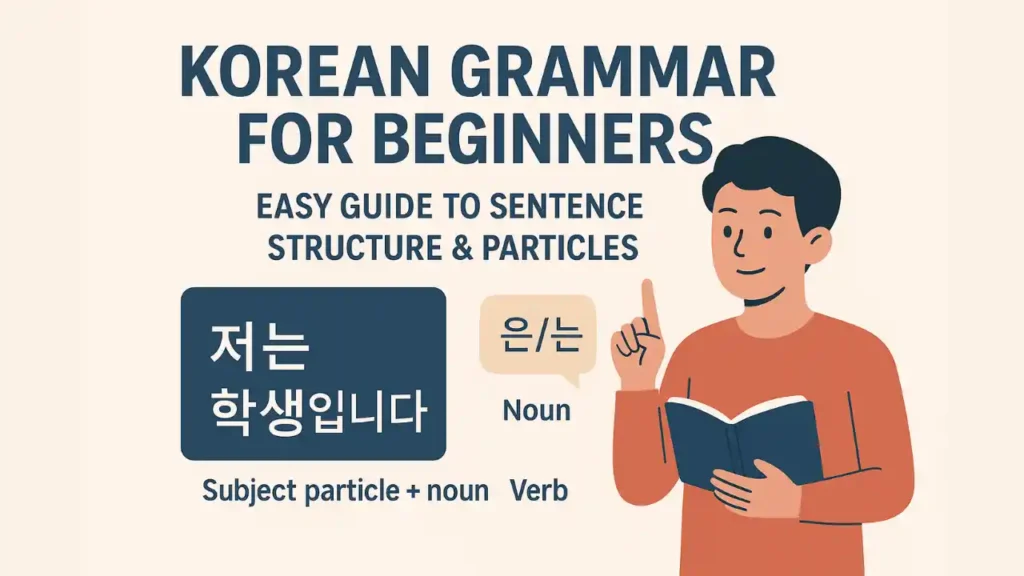
- 은/는 → Topic marker
- 저는 학생이에요. = As for me, I am a student.
- 이/가 → Subject marker
- 사과가 맛있어요. = The apple is delicious.
- 을/를 → Object marker
- 사과를 먹어요. = I eat an apple.
Think of particles as little signposts: they tell you who is doing what in the sentence.
👉 Without them, Korean sentences can feel confusing. With them, everything clicks into place.
3. Politeness Levels: Formal vs. Informal Speech
One thing that shocked me as a beginner was the idea of speech levels. In English, we speak the same way to everyone. In Korean, how you speak depends on who you’re talking to.
Common Levels:
- Formal (합니다체): Very polite, used in news or speeches.
- 감사합니다 = Thank you (formal).
- Polite (해요체): Most common for beginners, safe in everyday situations.
- 감사합니다 → 감사합니다 (same, polite tone).
- 먹어요 = (I) eat.
- Casual (해체): Used with friends, family, or younger people.
- 고마워 = Thanks.
- 먹어 = Eat.
👉 Example: Ordering food at a restaurant
- Polite: 김치찌개 주세요. = Please give me kimchi stew.
- Casual: 김치찌개 줘. (Only with close friends or younger people!)
As a beginner, stick with polite speech (–요 endings). It’s safe and widely used.
Read Also: RM Biography: The Inspiring Journey of BTS’s First Member
4. Everyday Grammar in Action
Let’s see Korean grammar come alive in daily situations.
Introducing Yourself
- 저는 마리아예요. = I am Maria.
- 저는 미국에서 왔어요. = I came from the USA.
Ordering Food
- 물 주세요. = Please give me water.
- 불고기 하나 주세요. = One bulgogi, please.
Talking About Daily Life
- 저는 한국어를 공부해요. = I study Korean.
- 친구를 만나요. = I meet a friend.
Notice how in every sentence, the verb comes last and particles show the roles of words.
5. Why Grammar Isn’t Scary
When I started, I thought I had to memorize endless rules before speaking. But Korean grammar is actually a tool to make communication easier.
Here’s why you shouldn’t fear it:
- Verbs always come last → predictable structure.
- Particles give clarity → no guessing who does what.
- Politeness levels guide respect → built-in cultural connection.
👉 Don’t aim for perfection. Even if you mix up a particle, Koreans will usually understand—and appreciate your effort.
Read Also: Tata Next-Gen Nano 2025: India’s Cheapest 4-Seater Car at ₹80,000 with 500KM CNG Range
FAQs About Korean Grammar for Beginners
Do I need to master grammar before speaking?
No! Start speaking early, even with simple sentences. Grammar improves naturally as you practice.
What’s the hardest part of Korean grammar?
Particles and speech levels. But once you learn the basics, they repeat often.
Can I skip formal speech and just use casual?
Not recommended. Using casual speech with strangers can sound rude. Stick with polite forms (–요 endings) until you’re confident.
How long does it take to understand Korean grammar basics?
With consistent practice, you can grasp beginner grammar in 2–3 months.
What’s the best way to practice grammar?
Make sentences daily. Even writing three simple sentences like “I eat rice,” “I watch TV,” “I go home” helps.
Conclusion
At first, Korean grammar for beginners feels like a maze: verbs at the end, mysterious particles, and tricky speech levels. But once you see the patterns, it becomes less about memorizing rules and more about telling your story in Korean.
Start small: learn a few essential particles, practice polite sentences, and don’t fear mistakes. The first time you confidently say “김치찌개 주세요” at a Korean restaurant, you’ll realize—grammar isn’t a wall, it’s a bridge to connection.
👉 Next step: Try making 3 sentences today using 은/는, 이/가, and 을/를. Speak them aloud. Congratulations—you’ve just unlocked the core of Korean grammar.
Pingback: Best Resources to Learn Hangul: The Complete Guide for Beginners 2025